
Commercial refrigeration
Cool room door seal: how to tell it’s failing
A cool room door seal is failing if you can see light around it with the room dark, a strip of paper slides out of the closed door with no drag or frost keeps building around the frame. Ice usually shows up before the room warms, so the frost is the early warning.
By Tania Elsafin5 min read
The short answer
Two tests you can do in ten minutes
The light test
With a second person outside holding the door, stand inside with the lights off and look for daylight around the seal. Never shut yourself in alone. Any light you can see is air getting through.
The paper test
Close the door on a strip of paper and pull it out. Repeat every 30cm or so all the way round, including the corners and the bottom sweep. Where the paper slides out with no drag, the seal is not sealing.
Look and feel
Run a hand along the seal. Splits, flattened or hardened rubber, lifted corners and a torn bottom sweep all leak even when the door looks shut.
Why a failing seal shows up as ice first
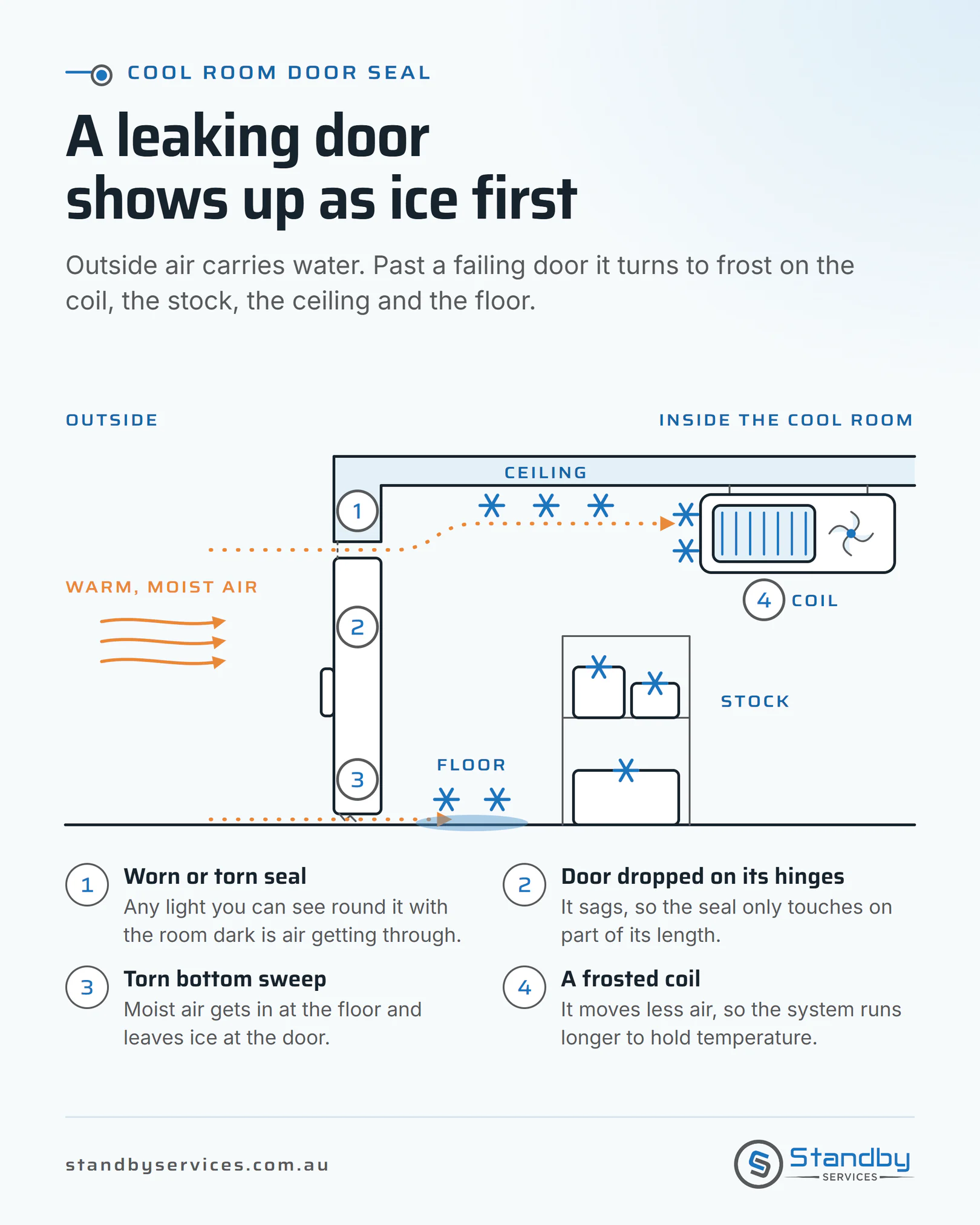
Outside air carries water. When it leaks into a cool room, that water comes out as frost on the evaporator coil, the stock, the ceiling and the floor. AIRAH, the air conditioning and refrigeration industry body, lists exactly those places in its cool room efficiency guidance.
The room pays for that leak twice. The system first cools the air, then has to melt its water back off the coil in defrost, which puts heat back into the room. A frosted coil also moves less air, so the refrigeration runs longer to hold temperature. By the time the back corner will not hold 5°C on a hot afternoon, the door has usually been leaking for weeks.
In a freezer the same water freezes on the door frame. The gasket sticks, someone yanks the door, the seal tears and the leak gets worse. For the temperatures each kind of room should hold, see what temperature a cool room should be.
Two kinds of door leak
A seal only matters while the door is shut. Most doors leak in both ways and a new seal fixes only one.
| Closed-door leaks | Open-door leaks | |
|---|---|---|
| Causes | Worn or torn seal, door dropped on its hinges, failed frame heater on a freezer | Door closer not pulling the door shut, doors propped open, no strip curtain |
| How you find them | Light test and paper test | Watching the door through a busy service or a delivery |
| The fix | New seal, hinge adjustment, heater repair | Closer repair, strip curtain, a door alarm and a no-chocking rule |
When the seal is fine and the door still leaks
Cool room doors are heavy and they drop on their hinges over time. Look at the gap around the closed door. If it is wider at the top on the latch side than at the hinge side, the door has sagged and the seal is only touching on part of its length. Rising or cam hinges lift the door as it swings and lower it onto the seal as it closes and they need adjusting as they wear. A closer that stops a few centimetres short leaves the door resting against the seal without pressing it home.
On a freezer room, a heater cable runs around the door frame to keep the gasket line from icing. When it fails, ice forms along the frame, the door freezes shut and the seal tears. Cool rooms at chiller temperatures usually do not need one. Frame heaters are electrical work and ice building on the coil rather than the door is a different fault that our freezer room page covers.
Stopping the open-door leaks
- A self-closer that pulls the door fully shut from any angle
- Strip curtains with overlapping strips, replaced when they split, go cloudy or stop overlapping
- A door-open alarm on rooms that get busy
- A rule against chocking the door open during deliveries
- Stock staged outside before the door opens, not carried in one box at a time
Replace the seal yourself or call a tech?
A push-in seal is a simple swap if you match the profile and there are several: two-finger, P-shaped, D-shaped and magnetic, on swing and sliding doors. The catch is the door. A new seal on a door that has dropped, a tired closer or a dead frame heater will be leaking again within weeks.
If you have the seal replaced, have the hinges, closer and heater checked on the same visit. On a scheduled refrigeration maintenance visit we test the door along with the rest of the room, so a failing seal gets caught as frost rather than as a room that will not hold temperature. If you want a price, it depends on the seal profile and length, the door type, whether the hinges, closer or heater need work too and whether it has to be done out of trading hours. We look at the door and give you a fixed quote.
Common questions
- How often should cool room door seals be replaced?
- There is no fixed interval. It depends on how often the door opens, how it is treated and whether it is a cool room or a freezer. Check the seal at every service with the light and paper tests and replace it when it fails them, not on a calendar.
- Why does my freezer room door freeze shut?
- Usually because the heater cable around the door frame has failed or the seal is letting moist air in. The moisture freezes on the frame and glues the gasket to it. Forcing the door open then tears the seal. The heater is electrical work, so it needs a technician.
- Do strip curtains make a difference on a cool room?
- Yes, on a door that opens often. They cut the warm, moist air that rolls in every time the door is open, which is when most air gets in on a busy room. They only work while the strips overlap and hang clean and clear, so replace split or cloudy strips.
- Why is there ice on the floor at the cool room door?
- Moist outside air is getting in at the bottom of the door and its water is freezing or condensing on the floor. Check the bottom sweep and whether the door has dropped on its hinges. Ice at the threshold is also a slip hazard, so fix the cause rather than scraping it each morning.