
Maintenance
Why is my air conditioner freezing up?
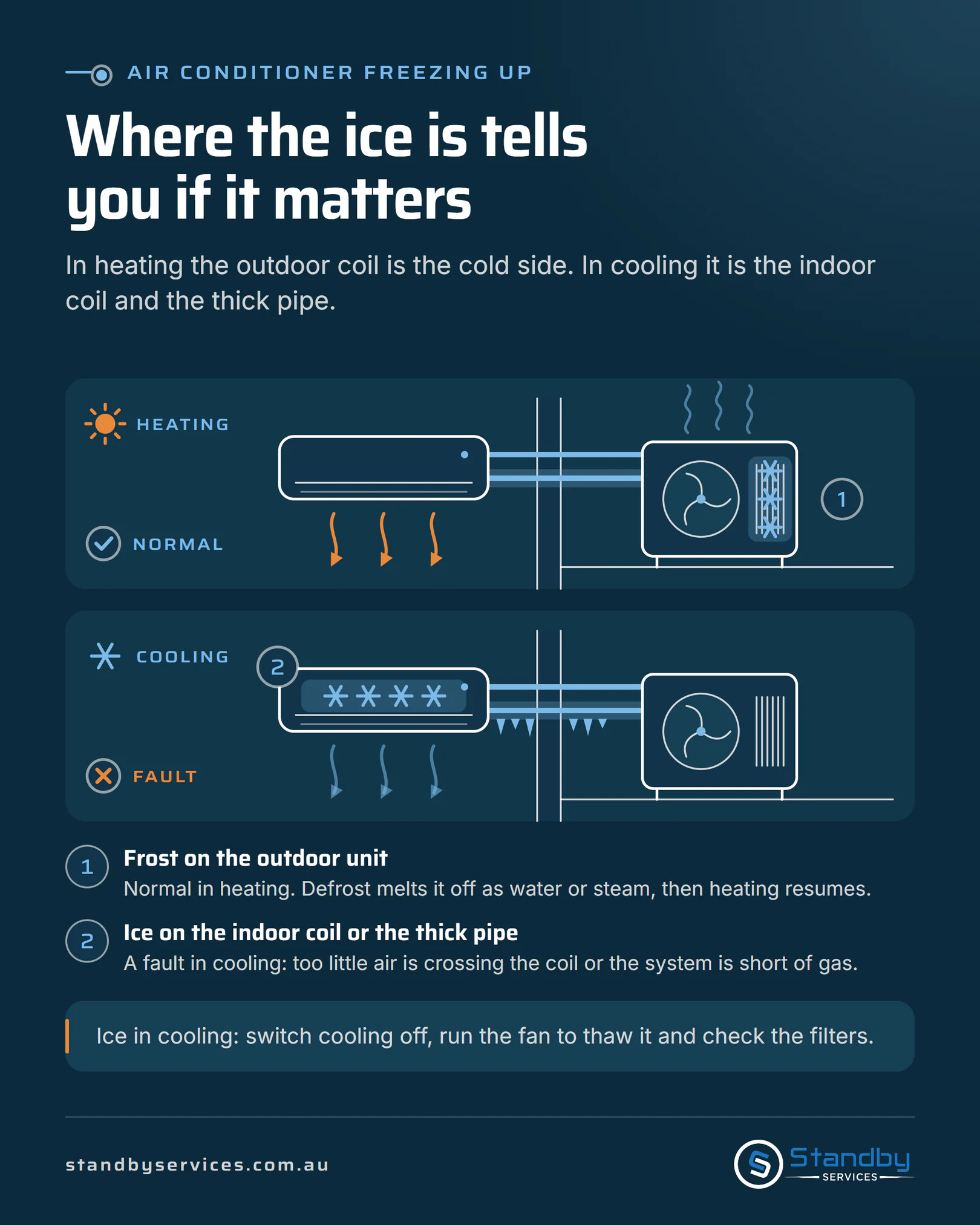
Frost on the outdoor unit while it is heating on a cold morning is normal: the system melts it off by itself. Ice on the indoor unit or the copper pipes while it is cooling is not. It means too little air is crossing the coil or the system is short of gas and it needs switching off.
By Tania Elsafin5 min read
The short answer
Where the ice is and whether it matters
| What you see | Mode | Normal or a fault? | What to do |
|---|---|---|---|
| Frost on the outdoor unit’s coil | Heating | Normal | Nothing. Defrost clears it |
| Steam from the outdoor unit and the indoor fan stops | Heating | Normal defrost | Wait. Heating resumes in a few minutes |
| Water beading on the pipes, no ice | Cooling | Normal condensation | Nothing |
| A thin mist from the indoor outlet | Cooling | Normal | Nothing |
| Ice on the indoor coil fins | Cooling | Fault | Switch cooling off, thaw, check the filters |
| Ice on the thick insulated pipe | Cooling | Fault | Switch cooling off, thaw, book a repair |
| A block of ice on the outdoor unit that never clears | Heating | Fault | Switch off and book a repair |
What a normal defrost looks like
In heating mode the outdoor coil is the cold side. On a cold, humid morning it drops below freezing and frost builds on its fins. Every reverse-cycle system is built to deal with that. Mitsubishi Electric says defrost starts when the outdoor coil is around 0°C, both fans stop and the compressor keeps running for about ten minutes. Fujitsu says up to 15 minutes, with the operation light blinking on the indoor unit. Daikin notes the frost comes off as water or steam.
So a system that stops blowing warm air on a July morning, goes quiet and sends a cloud off the outdoor unit is doing what it should. It may repeat every half hour or so while the weather stays cold and damp.
Why an air conditioner freezes up in cooling mode
In cooling, the indoor coil and the thick pipe running back to the outdoor unit are the cold side. They should run cold and wet, never icy. Ice forms when the coil gets colder than 0°C, which happens for one of two reasons: not enough warm room air is crossing the coil to keep it above freezing or there is not enough refrigerant in the circuit.
The usual causes, in the order to check them
- Clogged filters: the most common cause and the one you can fix yourself
- A dirty indoor coil behind the filters, which a service cleans
- The indoor fan stuck on its lowest speed or failing
- Cooling a room on a cool, humid night below the range the manual lists
- A refrigerant leak that has left the system short of gas
What to do right now
Switch cooling off. Run the system on fan only if it has that mode or turn it off and let the ice melt by itself. Put towels under the indoor unit, because a thawing coil drops more water than the drain can take. Do not chip at the ice and do not use a heat gun or hair dryer on the fins. When it has fully thawed, often an hour or more, clean the filters: our guide to cleaning an air conditioner filter shows how.
Then run it on cooling at a normal setting and watch. If the ice does not come back, the filters were the problem. If it ices up again with clean filters and the fan running, the cause is deeper: a blocked coil, a fan fault or a shortage of gas. Low gas always means a leak, which our guide to an air conditioner gas leak explains.
Water running down the wall as the ice melts is covered in why an air conditioner leaks waterand a system that runs without cooling in air conditioner not cooling.
Ducted systems freeze up too
On a ducted system the coil is in the roof, so you rarely see the ice. The signs are weak airflow from every outlet at once, a return air grille that is dusty or blocked by furniture and water through the ceiling after the system has been off for a while. Clear and clean the return air filter first. If it keeps happening, our ducted air conditioning repair page covers what we check.
Stopping it happening again
Clean the filters as often as your manual says, which for most split systems is every couple of weeks in heavy use. Keep the return air grille clear on a ducted system and do not run cooling far below the range in the manual on cool nights. A yearly air conditioning service cleans the coil, checks the fan and confirms the gas pressures before summer.
Common questions
- How do I unfreeze my air conditioner?
- Switch cooling off and run the system on fan only or switch it off completely and let the ice melt on its own. Put towels under the indoor unit for the meltwater. It often takes an hour or more. Do not chip or scrape the ice and do not use a heat gun, because the fins and pipes are easy to damage.
- Is my air conditioner ruined if it froze up?
- Usually not, if it was switched off when the ice was found. The risk is running it iced up for days or letting it happen again and again, which can send liquid refrigerant back to the compressor. Fix the cause once and the system normally carries on as before.
- Why is steam coming from my outdoor unit in winter?
- That is the defrost cycle. In heating mode on a cold, damp morning, frost builds on the outdoor coil and the system stops heating for a few minutes to melt it. The melting frost comes off as water and a cloud that looks like steam or white smoke. It is normal.
- Why does my split system keep icing up even with clean filters?
- With clean filters and a working fan, repeated icing usually points to a shortage of refrigerant from a leak or to a coil blocked deeper than the filter. Both need a licensed technician. Topping up the gas without finding the leak will only bring the ice back.