
Maintenance
Air conditioner gas leak: the signs and why a regas alone won’t fix it
An air conditioner does not use up its gas. The refrigerant goes round a sealed circuit for the life of the system, so a unit that needs gas has a leak and topping it up without finding the leak only buys a few weeks.
By Tania Elsafin5 min read
The short answer
Signs your air conditioner is low on gas
One of these on its own can have another cause. Two or three together point strongly at a leak.
- The air from the vents is cool rather than cold and the room never reaches the set temperature
- Frost or ice on the copper pipes at the outdoor unit or on the indoor coil
- A steady hiss or bubbling sound near the pipes or the outdoor unit
- An oily film on a pipe joint, often at the connections on the side of the outdoor unit
- The outdoor unit runs and runs without cycling off
- An error code on the indoor unit that the manual lists as a refrigerant or low-pressure fault
Why a regas on its own won’t fix it
Search for aircon regas and most of what comes up is about cars. A car system loses a little gas through its hoses and seals every year and gets topped up at a service. A split or ducted system at home is different. Its pipes are copper, its joints are flared or brazed and the circuit is sealed at installation. If the gas is low, it went out through a hole.
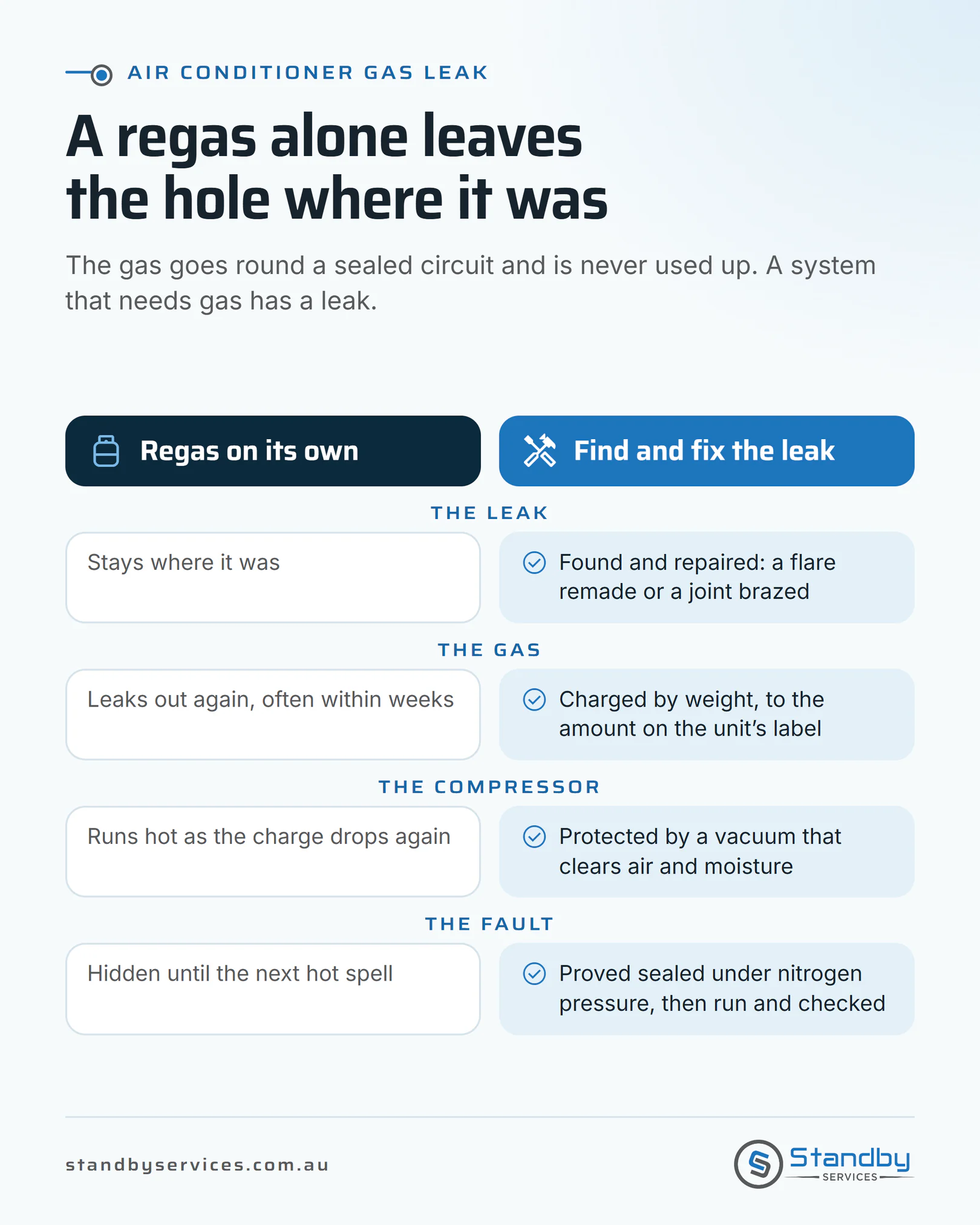
Topping up without fixing the leak means paying for gas that ends up in the air, often within weeks. It also hides the fault until the next hot spell, when the charge drops again and the compressor runs hot trying to make up for it.
The right order is the other way round: find the leak, repair it, pressure test the system, pull a vacuum to clear out air and moisture, then charge it with the correct weight of the gas on the unit’s label. Older systems add a complication. An R22 unit cannot simply be refilled with a newer gas, which our guide to R32 refrigerant explains.
Where air conditioner gas leaks come from
Most leaks start at a joint. Flare connections at the indoor and outdoor units loosen slightly with years of vibration and heating and cooling cycles. A poorly made flare on install day can leak from the first summer.
Corrosion is the next most common cause. On the Illawarra coast, salt air eats at the outdoor coil and the pipe connections. Inside the house, some copper indoor coils develop pinhole leaks from formicary corrosion, a slow chemical attack from household vapours that leaves tiny tunnels through the copper wall. Those leaks are hard to find and often mean replacing the coil.
Physical damage accounts for the rest: a whipper snipper or a dog against the pipe cover, a pipe crushed behind a panel or a unit knocked on its bracket.
How a technician finds and fixes the leak
Check the charge and the symptoms
Gauges on the service valves show whether the pressures are low for the conditions, which confirms gas is the problem rather than airflow or a dirty coil.
Find the leak
An electronic leak detector and bubble solution on the joints and coils. For small leaks the system is emptied and pressurised with nitrogen so the leak can be found without losing more refrigerant.
Repair it
Remaking a flare, brazing a joint or replacing a coil or valve, depending on where it is.
Pressure test and vacuum
The repaired system holds nitrogen pressure to prove it is sealed, then a vacuum pump removes air and moisture that would damage the compressor.
Charge by weight and test
The system is charged with the amount of gas on its label and run to check pressures, temperatures and cooling.
Only a licensed technician can handle the gas
In Australia, handling refrigerant needs a licence under the Ozone Protection and Synthetic Greenhouse Gas Management Act 1989. The Australian Refrigeration Council issues the refrigerant handling licence and the federal environment department's guidance on refrigerant recovery says it is illegal to release controlled refrigerant into the air. That rules out the top-up cans sold for cars and anyone who offers to regas a home system without the licence.
Standby is an ARC member with a refrigerant purchasing licence and every tech is Certificate 3 qualified. We carry the gas, the gauges and the leak detection gear and we record what goes into your system.
Repair or replace a leaking system
A leak at an outdoor joint on a system a few years old is usually worth fixing. A leak in the indoor coil of a system past 12 or 15 years or any leak on an R22 system, is where replacement starts to make more sense. Our guide to how long air conditioners last covers the signs and when a new system is the better call our air conditioner replacement page explains how we quote it, with every NSW Government incentive you are eligible for included.
If your system is running but the air is only lukewarm and you are not sure it is gas, start with our guide to an air conditioner that runs but does not cool. A hiss is one of the noises covered in why an air conditioner makes noise.
Common questions
- Can I still run my air conditioner if it’s leaking gas?
- Best not to. As the charge drops, the compressor works harder for less cooling and can overheat and ice can build on the indoor coil and melt through the ceiling or down the wall. Switch it off and book a technician to find the leak.
- Is an air conditioner gas leak dangerous?
- A household split system holds a small amount of refrigerant. If you smell something odd or hear a steady hiss, switch the system off, open a window and keep flames and sparks away, because R32, the gas in most new systems, is mildly flammable. Then call a licensed technician.
- How often does an air conditioner need regassing?
- Never, if nothing is leaking. The gas circulates in a sealed loop and is not consumed. A system that needs a regas every summer has a leak that has never been fixed.
- How much does it cost to fix an air conditioner gas leak?
- It depends on where the leak is, how easy it is to reach, whether a part such as a coil needs replacing, the type and amount of gas and the age of the system. We find the leak first, then give you a fixed price for the repair. On an older system that price sits beside a replacement quote so you can compare.