
Air conditioning
What is R32 refrigerant?
R32 is the refrigerant gas in most new split system air conditioners sold in Australia. It moves heat about as well as the gases before it, with around a quarter of the global warming effect of R410A. It is mildly flammable and it only goes into systems designed for it.
By Tania Elsafin5 min read
The short answer
Why nearly every new air conditioner uses R32
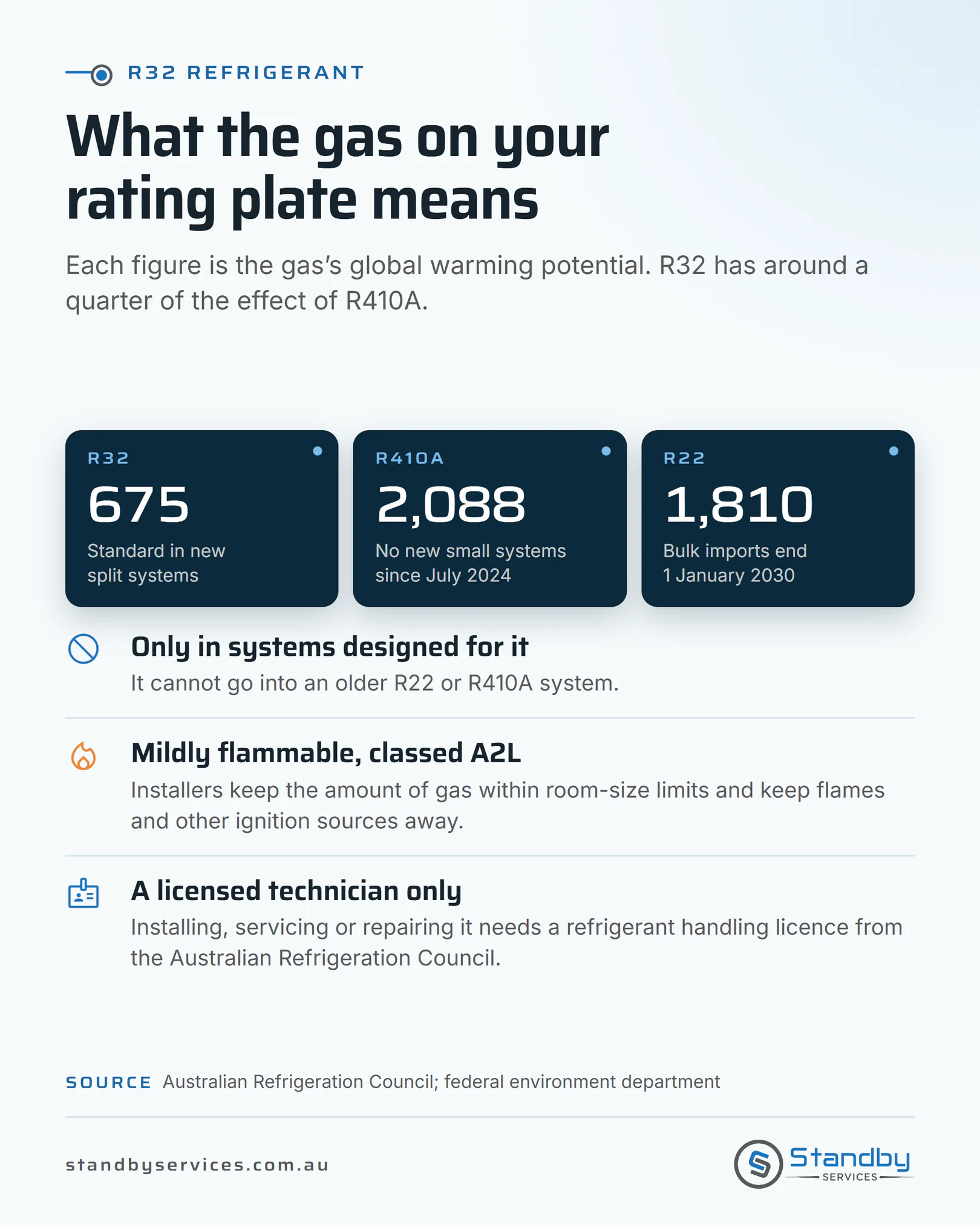
Since 1 July 2024, Australia has banned importing or making small air conditioners designed for a refrigerant with a global warming potential over 750, as the Australian Refrigeration Council's notice of the ban sets out. That covers split systems, window and wall units and portables. R410A, the gas most splits used for the previous 15 years, sits at 2,088, so manufacturers moved their small systems across to R32. Ducted systems are outside that ban, so some still use R410A.
The change affects what can be sold new. A system already on your wall running R410A is fine to keep, service and repair.
R32 vs R410A vs R22
| R32 | R410A | R22 | |
|---|---|---|---|
| Global warming potential | 675 | 2,088 | 1,810 |
| Damages the ozone layer | No | No | Yes |
| Flammability class | A2L, mildly flammable | A1, non-flammable | A1, non-flammable |
| Single gas or blend | Single gas | Blend, half R32 | Single gas |
| Status in Australia | Standard in new split systems | No new small systems since July 2024 | Bulk imports end 1 January 2030 |
| Can it go into the others’ systems? | No | No | No |
Figures from the Australian Refrigeration Council's R32 information and its fact sheet on R22. The R22 global warming potential is from the Department of Climate Change, Energy, the Environment and Water's rules on charging equipment.
Is R32 safe in a home?
Yes, installed properly. R32 is classed A2L under AS/NZS ISO 817, which means lower flammability. It becomes a risk when a leak lets enough gas collect in one space, which is why the Australian Refrigeration Council tells technicians to keep it away from open flames and other ignition sources. The realistic risk is a leak in a small room with an open flame such as a gas heater.
That is why installers follow room-size charge limits under AS/NZS 5149 and the manufacturer’s tables and why R32 work needs a licensed technician with the right tools. If you ever smell something odd or hear a steady hiss from a system, switch it off, open a window and call a technician.
Can an R22 air conditioner be topped up with R32?
No. The Australian Refrigeration Council says R32 must only be used in systems specifically designed for it and is not a drop-in replacement. An R22 system was built for a different gas, different oil and different pressures and it was never designed around a flammable refrigerant.
R22 itself is on the way out. Bulk imports have been capped since 2016 and end on 1 January 2030, after which any R22 for servicing comes from recycled or reclaimed stock. Existing R22 systems are not banned and can keep running and being serviced, but the gas and parts get harder and dearer to find.
So an R22 system that needs gas has three options: repair the leak and recharge it with R22 while stock lasts, have a licensed technician convert it to a non-flammable replacement gas where the system suits it or replace it. Our advice is the same as on our air conditioner replacement page: a leak or failed pipework on an R22 unit usually means it is time to replace it, while an electrical fault can still be worth fixing.
How to tell which gas your air conditioner uses
Look at the rating plate, a sticker on the side or back of the outdoor unit. It names the refrigerant type and how much the system holds. R22 usually means a system from before about 2010, which puts it at the older end of the range covered in our guide to how long air conditioners last.
Who can work on R32 systems
Only a technician with a refrigerant handling licence from the Australian Refrigeration Council can install, service or repair a system that holds refrigerant and a business needs a trading authorisation to buy the gas. Releasing refrigerant on purpose is an offence. The federal environment department's guidance on refrigerant recovery says it is illegal to release controlled refrigerant into the air.
Standby’s tradesmen are Certificate 3 qualified and licensed to handle refrigerant and the business holds a refrigerant trading authorisation. If your system is short of cooling and you suspect gas, start with our guide to an air conditioner that runs but does not cool or book a repair.
Common questions
- Is R32 refrigerant flammable?
- Mildly. R32 is classed A2L, lower flammability, under AS/NZS ISO 817. It becomes a risk when enough of it collects in one space, so installers keep the amount of gas within limits set by the smallest room the system serves and keep flames and other ignition sources away while they work. That is why system sizes and pipe lengths follow the manufacturer’s tables.
- Can I replace R22 with R32 in my air conditioner?
- No. The Australian Refrigeration Council says R32 must only be used in systems specifically designed for it and an R22 system is not. The options for an R22 unit are repairing it and recharging it with R22 while stock lasts, a licensed conversion to a non-flammable gas where the system suits it or replacing it.
- Is R32 being banned or phased out in Australia?
- No. R32 is covered by the HFC phase-down, which has cut the amount of these gases that can be imported each year since 2018. That limits supply over time. It does not ban R32 or the systems that already use it.
- Can I buy R32 and regas my own air conditioner?
- No. Handling refrigerant needs a refrigerant handling licence and buying it needs a trading authorisation, both issued by the Australian Refrigeration Council. A system that needs gas also has a leak and topping it up without fixing the leak does not solve anything.