
Air conditioning
How ducted air conditioning zones work
A zone is a group of rooms on its own motorised damper. Close a zone and the damper shuts off the air to those rooms, so the system only cools or heats the parts of the house you are using. The one catch is that the system still needs somewhere to push its air.
By Tania Elsafin5 min read
The short answer
How ducted air conditioning zones work
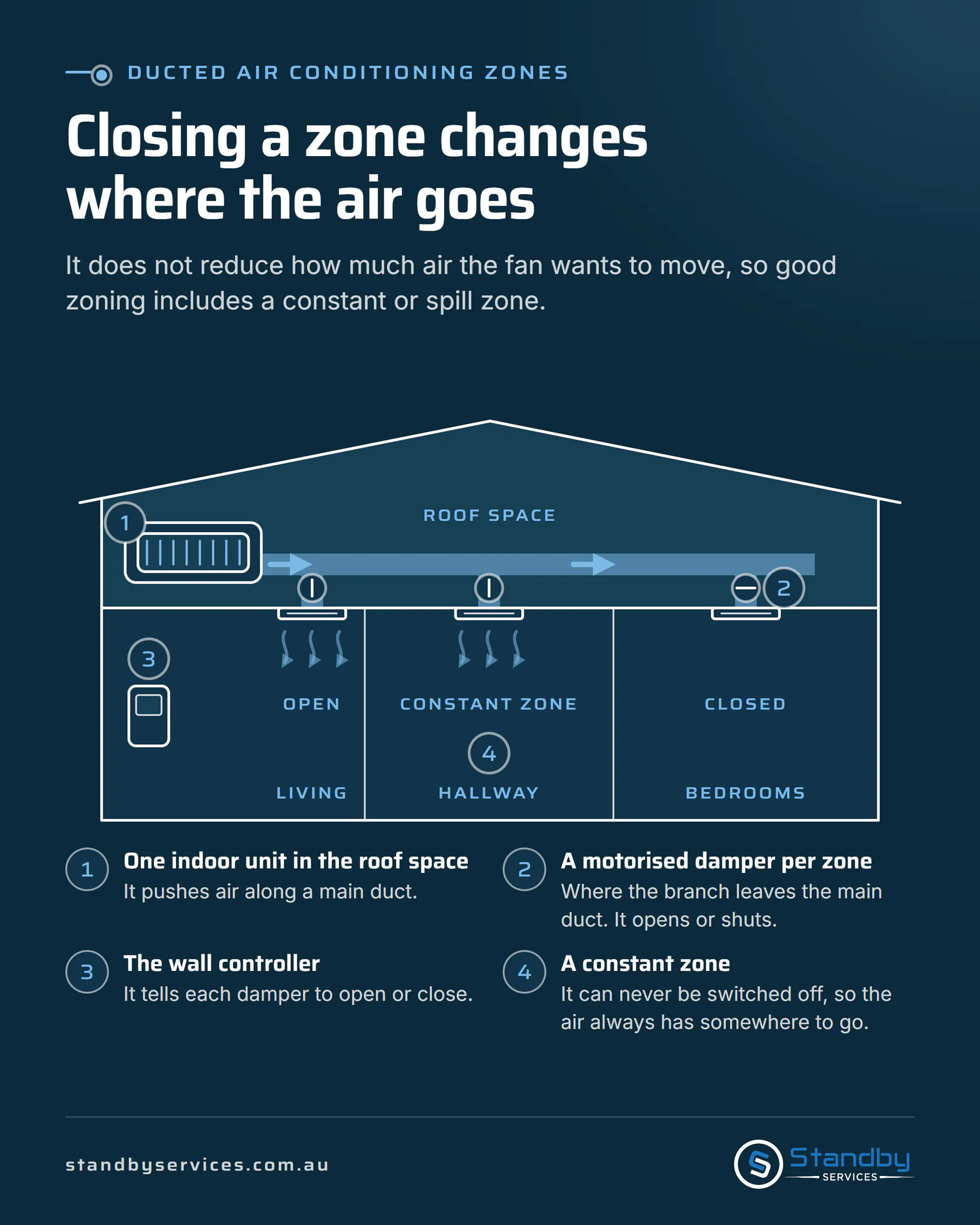
A ducted system has one indoor unit in the roof space that pushes air along a main duct, which branches out to outlets in each room. Zoning puts a damper, a flap driven by a small motor, where each branch or group of branches leaves the main duct. The wall controller tells each damper to open or close.
On a basic system, zones are on or off and one thermostat sets the temperature for the whole house. With a temperature sensor in each zone, the controller can hold the bedrooms at one temperature and the living room at another by opening each damper more or less. Controllers from AirTouch, MyAir, iZone and the major air conditioner brands work this way, many with a phone app.
Why a zoned system needs somewhere to spill air
Here is the part most guides skip. Closing a zone changes where the air goes. It does not reduce how much air the fan wants to move. An inverter system turns its compressor down when fewer zones are open, but the indoor coil still needs a minimum amount of air flowing across it.
If you close all but one small bedroom, that air has only one place to go. The result is a roaring outlet, a whistling duct, a coil that can get too cold and in bad cases a flexible duct pushed off its fitting in the roof. Modern systems have protection that shuts the compressor down before real damage, but a system that keeps tripping itself out is not doing its job.
Three ways systems deal with it
| Method | How it works | Where it suits |
|---|---|---|
| Constant zone | A zone that can never be switched off, usually a hallway or living area | Simple systems with on-off zones |
| Spill zone | A zone the controller opens automatically when too few others are open | Systems where every room needs to switch off at times |
| Bypass damper | A spring-loaded or motorised damper that returns extra air to the return side | Systems with temperature control in each zone |
Which one is right depends on the unit, the controller and the duct layout, so it is decided at the design stage.
How many zones you need
Group rooms that get used at the same time and face the same way. A west-facing living room that bakes in the afternoon and a south-facing bedroom that stays cool should not share a zone, because one of them will always be wrong. Most homes come out at three to six zones.
Two-storey homes nearly always need upstairs and downstairs on separate zones, since heat rises and the upstairs rooms need more cooling in summer. Very large homes can be better served by two smaller systems than one big one with many zones.
Getting the most out of your zones
- Run only the zones you are using, but leave the constant or spill zone alone
- Close bedroom zones during the day and living zones at night
- Set temperatures by zone if your controller allows, rather than cooling the whole house to the coldest setting
- Keep the return air grille and its filter clean, because every zone draws through it
- Close doors between zoned areas so conditioned air stays where you paid to put it
When a zone stops working
A zone that stays hot, will not open or rattles when it should be shut usually has a damper motor or controller fault or a duct that has come loose in the roof. Our ducted air conditioning repair page covers those faults. If you are planning a new system, see ducted air conditioning or go straight to ducted air conditioning in Wollongong or ducted air conditioning in Sydney if that is where you live. Our guide to choosing ducted or split system helps if you are still deciding.
Common questions
- How many zones should a ducted system have?
- Most homes end up with between three and six and the number follows how you live rather than how many rooms there are. A common split is living areas, main bedroom, kids’ bedrooms and a study or upstairs. Every zone adds a damper and a duct run, so more is not automatically better.
- Can you run just one zone on ducted air conditioning?
- Yes, on a well-designed system. It needs a constant zone, a spill zone or a bypass so enough air keeps moving across the indoor unit when one small zone is open. On a system without one, running a single bedroom can make it noisy or trip a safety cut-out.
- Is it cheaper to run one zone on ducted air conditioning?
- Usually, yes, because an inverter system slows down when it has fewer rooms to condition. The saving is smaller than the floor area suggests, since some air goes to the constant or spill zone. Setting the temperature one degree closer to the outside makes a similar difference: each degree adds around 5 to 10 percent to energy use.
- Can zones be added to an existing ducted system?
- Often, yes. Dampers can be fitted into the existing ductwork and a zone controller wired in, as long as the duct layout allows the rooms to be grouped sensibly and the system can cope with the smaller airflow. We check both before quoting.